Beyond Structural Quality: The RIGHTS Framework for Child-Rights-Responsive Quality in Early Childhood Education
Kata Kunci:
child rights, early childhood education, participation, process quality, quality assurance, safeguardingAbstrak
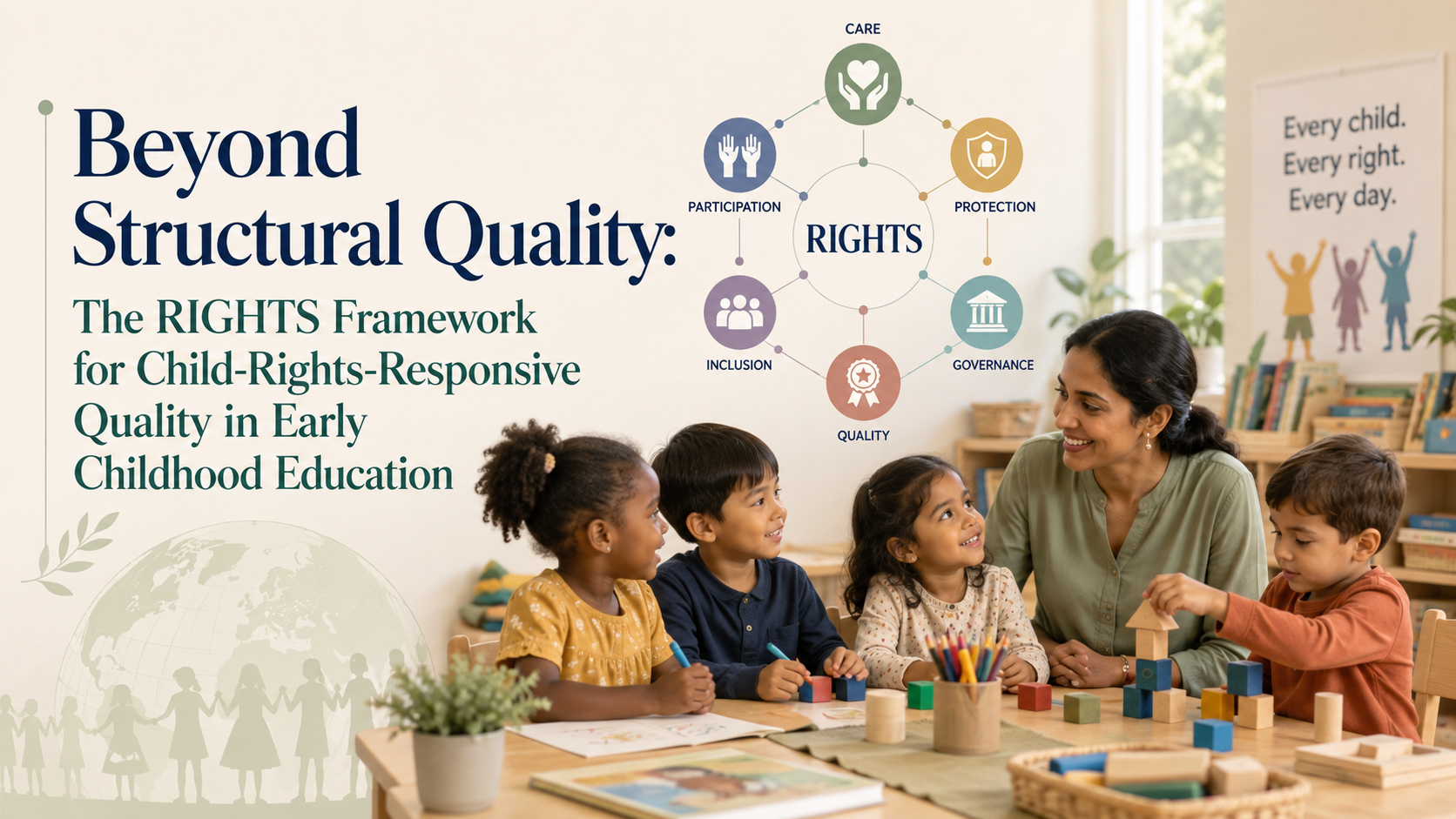
Quality in early childhood education and care (ECEC) is still commonly represented through structural indicators such as staff qualifications, child-to-adult ratios, facilities, curriculum documentation and administrative compliance. These conditions matter, but they do not by themselves show whether children are listened to, included, protected, responded to or supported when a concern has been identified. This conceptual-policy article develops the RIGHTS Framework as a child-rights-responsive approach to ECEC quality. A directed conceptual synthesis was conducted across four source groups: international child-rights instruments, established ECEC quality, participation and rights-oriented monitoring frameworks, evidence on process quality and integrated early-years services, and current Indonesian education and child-protection policy. Concepts were first clustered by substantive meaning; the mnemonic RIGHTS was assigned only after six domains had been derived. The framework comprises Responsive relationships, Inclusion and non-discrimination, Genuine participation, Harm prevention and safeguarding, Tracking and follow-up, and Shared responsibility. RIGHTS is explicitly multilevel and multi-method: it distinguishes child-facing interaction, organisational safeguards, continuity and accountability, and ecological or interprofessional support, while treating children's rights as a normative lens across the whole system rather than as an end-point. Twenty-four candidate indicators are proposed for empirical validation, with evidence drawn from observation, children's perspectives, records and procedures, family input and interprofessional coordination. The framework is not presented as a validated scale and should not yet be used to produce high-stakes composite scores. Its contribution is to connect structural conditions, process quality, rights, safeguarding and follow-up in a single testable architecture for quality improvement.
Referensi
Committee on the Rights of the Child. (2009). General Comment No. 12 (2009): The right of the child to be heard (CRC/C/GC/12). United Nations.
Committee on the Rights of the Child. (2013). General Comment No. 14 (2013) on the right of the child to have his or her best interests taken as a primary consideration (art. 3, para. 1) (CRC/C/GC/14). United Nations.
Committee on the Rights of the Child. (2023). General Comment No. 7 (2020) on implementing children's rights in early childhood (CRC/C/GC/7/Rev.2). United Nations.
Correia, N., Camilo, C., Aguiar, C., & Amaro, F. (2019). Children's right to participate in early childhood education settings: A systematic review. Children and Youth Services Review, 100, 76-88. https://doi.org/10.1016/j.childyouth.2019.02.031
Edwards, S. (2021). Process quality, curriculum and pedagogy in early childhood education and care. OECD Education Working Papers, No. 247. OECD Publishing. https://doi.org/10.1787/eba0711e-en
Fukkink, R., & Lalihatu, E. S. (2020). A realist synthesis of interprofessional collaboration in the early years: Becoming familiar with other professionals. International Journal of Integrated Care, 20(3), Article 16. https://doi.org/10.5334/ijic.5482
Ha, N. T. N., Tham, M., & Hurley, P. (2025). Process quality in early childhood education and care in Australia: A systematic literature review. Early Childhood Education Journal, 53, 2193-2206. https://doi.org/10.1007/s10643-024-01735-4
Harms, T., Clifford, R. M., & Cryer, D. (2015). Early Childhood Environment Rating Scale (3rd ed.). Teachers College Press.
Henderson-Dekort, E., & May, J. (2024). Reconceptualizing early childhood educators as champions for children's rights: Introduction of the Children's Rights Advancement Framework. Canadian Journal of Children's Rights / Revue canadienne des droits des enfants, 11(1), 38-56. https://doi.org/10.22215/cjcr.v11i1.4816
Kementerian Pendidikan Dasar dan Menengah Republik Indonesia. (2025). Peraturan Menteri Pendidikan Dasar dan Menengah Republik Indonesia Nomor 26 Tahun 2025 tentang Standar Pengelolaan pada Pendidikan Anak Usia Dini, Jenjang Pendidikan Dasar, dan Jenjang Pendidikan Menengah.
Kementerian Pendidikan Dasar dan Menengah Republik Indonesia. (2026a). Peraturan Menteri Pendidikan Dasar dan Menengah Republik Indonesia Nomor 1 Tahun 2026 tentang Standar Proses pada Pendidikan Anak Usia Dini, Jenjang Pendidikan Dasar, dan Jenjang Pendidikan Menengah.
Kementerian Pendidikan Dasar dan Menengah Republik Indonesia. (2026b). Peraturan Menteri Pendidikan Dasar dan Menengah Republik Indonesia Nomor 6 Tahun 2026 tentang Budaya Sekolah Aman dan Nyaman.
La Paro, K. M., Pianta, R. C., & Stuhlman, M. (2004). The Classroom Assessment Scoring System: Findings from the prekindergarten year. The Elementary School Journal, 104(5), 409-426. https://doi.org/10.1086/499760
Lundy, L. (2007). 'Voice' is not enough: Conceptualising Article 12 of the United Nations Convention on the Rights of the Child. British Educational Research Journal, 33(6), 927-942. https://doi.org/10.1080/01411920701657033
OECD. (2021). Starting Strong VI: Supporting meaningful interactions in early childhood education and care. OECD Publishing. https://doi.org/10.1787/f47a06ae-en
Ooms, M., Fukkink, R., Devlieghere, J., Dreier, A., Fischbach, R., Langner, J., Mæland Strømsøe, K., & Van Lombergen, L. (2026). Interprofessional collaboration in ECEC: A review of European countries with different levels of system integration. European Early Childhood Education Research Journal, 34(1), 74-89. https://doi.org/10.1080/1350293X.2025.2484266
Pacheco-Molero, M., Morales-Murillo, C., León-Estrada, I., & Gutiérrez-Ortega, M. (2025). Barriers perceived by professionals in family-centered early intervention services: A systematic review of the current evidence. International Journal of Early Childhood, 57, 357-377. https://doi.org/10.1007/s13158-024-00401-5
Pianta, R. C., Downer, J., & Hamre, B. (2016). Quality in early education classrooms: Definitions, gaps, and systems. The Future of Children, 26(2), 119-137. https://doi.org/10.1353/foc.2016.0015
Pianta, R. C., & Hofkens, T. (2023). Defining early education quality using CLASS-observed teacher-student interaction. Frontiers in Psychology, 14, 1110419. https://doi.org/10.3389/fpsyg.2023.1110419
Powell, M. A., Taylor, N., Fitzgerald, R., Graham, A., & Anderson, D. (2013). Ethical research involving children. UNICEF Office of Research - Innocenti.
Republic of Indonesia. (2014). Law of the Republic of Indonesia Number 35 of 2014 concerning Amendment to Law Number 23 of 2002 concerning Child Protection.
Republic of Indonesia. (2016). Law of the Republic of Indonesia Number 17 of 2016 concerning the Enactment of Government Regulation in Lieu of Law Number 1 of 2016 on the Second Amendment to Law Number 23 of 2002 concerning Child Protection into Law.
Right to Education Initiative. (2025). Monitoring early childhood care and education from a human rights perspective. Right to Education Initiative. https://www.right-to-education.org/resource/monitoring-early-childhood-care-and-education-human-rights-perspective
Slot, P. (2018). Structural characteristics and process quality in early childhood education and care: A literature review. OECD Education Working Papers, No. 176. OECD Publishing. https://doi.org/10.1787/edaf3793-en
Sluiter, R. M. V., Fukkink, R. G., & Fekkes, M. (2025). The impact of process quality in early childhood education and care on socio-emotional development: A meta-analysis of longitudinal studies. International Journal of Environmental Research and Public Health, 22(5), 775. https://doi.org/10.3390/ijerph22050775
Støve, L. L., Dalgaard, N. T., Mohr, J. W., Hansen, J. E., Wendelboe, K. I., Hestbaek, E., Vieira, C. C., Væver, M. S., & Smith-Nielsen, J. (2026). Individual and structural factors associated with interactive skills of child-care professionals in early childhood education and care: A systematic review and meta-analysis. Educational Psychology Review, 38, Article 74. https://doi.org/10.1007/s10648-026-10162-3
UNESCO & UNICEF. (2024). Global report on early childhood care and education: The right to a strong foundation. UNESCO.
United Nations. (1989). Convention on the Rights of the Child. United Nations.
World Health Organization, United Nations Children's Fund, & World Bank Group. (2018). Nurturing care for early childhood development: A framework for helping children survive and thrive to transform health and human potential. World Health Organization.
World Health Organization, United Nations Children's Fund, World Bank Group, Early Childhood Development Action Network, Partnership for Maternal, Newborn & Child Health, & Every Woman Every Child. (2019). Operationalizing nurturing care for early childhood development: The role of the health sector alongside other sectors and actors. World Health Organization.
Unduhan
Diterbitkan
Terbitan
Bagian
Lisensi
Hak Cipta (c) 2026 Hamid Patilima

Artikel ini berlisensi Creative Commons Attribution 4.0 International License.
Creative Commons Attribution 4.0 International (CC BY 4.0)